Cabinet
Pricing Guide
If you are doing a kitchen or bath remodel, chances are a major focus of the remodel will be the cabinets. What they look like, how they function, and, of course, how much they will cost. Cabinets, especially in a kitchen, are generally one of the highest costs besides labor involved in a kitchen or bath remodel. So let’s break it down so you have all the knowledge you need to make the most informed buying decision.
The question of “how much do cabinets cost” is so ambiguous because there are a multitude of variables that affect the cost of your specific cabinets.
-
Build quality
Build style
Wood type
Finish type
Region
Hardware quality
Warranty
Number of cabinets
Type of cabinets
Drawers vs doors
Bases vs talls
End panel upgrades
Trim finishes
Door style
Internal accessories
Cabinet size availability
Honestly, the list goes on and on. Each one is an option for your kitchen.
But if I had to narrow this down to one defining aspect that you can use as an easy metric to gauge the cost from vendor to vendor or manufacturer to manufacturer, it’s this:
The more choices you have available, the more expensive the cabinet line.
More choices = more money, while fewer choices = less money
In the cabinet world, you might hear this spectrum of pricing for different cabinet lines expressed like this
Stock, RTA, RTA Assembled, Value semi-custom, Semi-custom, Custom
-
These are off-the-shelf cabinets, and examples would be cabinets you can buy off the shelf at Home Depot. Because they are stocking them, they have limited options for size, finish, and style
-
Stands for ready-to-assemble and typically has limited color/door options, but much more options than stock. Even within this category of cabinets, you have a wide range of build quality, door styles, finishes, and size options depending on the manufacturer. These types of cabinets generally have pretty quick lead times (2-3 weeks) because they are not “Made to order” but rather are inventoried and assembled when specified. Modifications and alterations to the cabinets are generally very restrictive as they are not made to order. For purposes of this pricing guide, we are going to assume that cabinets in this category are finished as well.
-
Same concept as RTA, but this category of cabinets will be assembled and ready to install before being delivered to your home.
-
This is where you start getting into “made-to-order” cabinets. The Value semi-custom keeps the price lower by still restricting your available options. They are generally made in the same factories as the semi-custom/custom lines. Many manufacturers will have a “custom” line and then offer a semi-custom or value semi-custom line that is produced in the same facility. Literally the only difference is that the size and style options are more restricted. The lead times when you get to order cabinets are typically around 6-7 weeks on average. Any less than that, and you are more than likely working with a cabinet line between RTA and semi-custom.
-
It's pretty close to value semi-custom, with only probably a 5-10% price difference between the two. Every manufacturer will have a different number of optics and sizes in their restricted line, so it varies
-
This is where your options can become almost limitless. Only confined to the bounds of human technology and manufacturing capabilities and within the bounds of physics. Custom cabinets can also be called “Designer Grade,” “Luxury Grade,” Architectural Millwork,” and “Spec Grade.”
For things like Warranty, build quality, hardware quality, etc as you go up in price, the quality and warranties increase. Not always hand in hand between each same-grade manufacturer, but the quality of a stock Home Depot cabinet is vastly inferior to a custom cabinet without a doubt.
With that being said, at this point I want to point out that regardless of price, we are still talking about wood crafted by human hands. Assembled and installed by humans. Shipped and transported by humans. Wood that varies in color based on the soil it’s born into. Whenever you are working with natural materials, you should expect natural variations and imperfections. Any item, no matter the cost, will have some imperfections if put under an electron microscope. The difference is made in the installation and the follow-up from the manufacturer and dealer to handle issues outside of natural variations and standard building practices.
What's the cost then?
Stock cabinets
From Home Depot's site
Ready to ship in 1-2 days
Unfinished and “Ready to Assemble” (you have to finish and assemble them)
Base cabinets: $100-$215 per cabinet. I would average about 165 per base cabinet or 84 $/Lineal Foot of face frame
Wall cabinets: $65 and $187 per wall cabinet; I would average about 145 per wall cabinet or 72$/Lineal Foot of face frame
Tall cabinets: $450 – $641 average $588 or $288 $/LF of face frame (double-check)
This option is going to be by far and away the cheapest option you will find.
Pros: Extremely good price, very quick (within a week)
Cons: You have to finish the cabinets yourself or pay someone to do it. You have to assemble them yourself or pay someone to do it. You have to design and order cabinets yourself.
I also can't speak to the build quality here because I have never used these cabinets
-
Walls: approximately 165 $/LF of face frame
Bases: 272 $/LF of face frame
Talls: 430 $/LF of face frame
This would be just for cabinets; we will talk trims here. Link below
Pros: A good range of options, cost-effective, solid build quality, quick lead time (2-3 weeks)
Cons: Not unlimited options, some limitations on sizes, limitations on modifications
-
Walls:
Bases:
Talls:
-
Wall cabinets: 500-525 $/Lineal Foot of face frame
Base Cabinets: 700-725 $/Lineal Foot of face frame
Tall Cabinets: 1700-1800 $/Lineal Foot of face frame
Easier budgeting method
(Wall pricing model)
The cabinet pricing guide listed for all of the cabinet types is designed to be used for an entire kitchen and does not work as well when used for a single cabinet. For example, a single custom sink base might be closer to 425 $/LF of face frame, while a 3 Drawer base is 710 $/LF of face frame, and a BFH09 is closer to 1576 $/LF of face frame.
-
This article will help you find the best type of cabinet manufacturer for your project needs. We are going to talk about pricing, options, performance, construction, and problems. With this, you can ask the right questions the next time you're looking for cabinets and know what is going to work best for your home! Lets go!
-
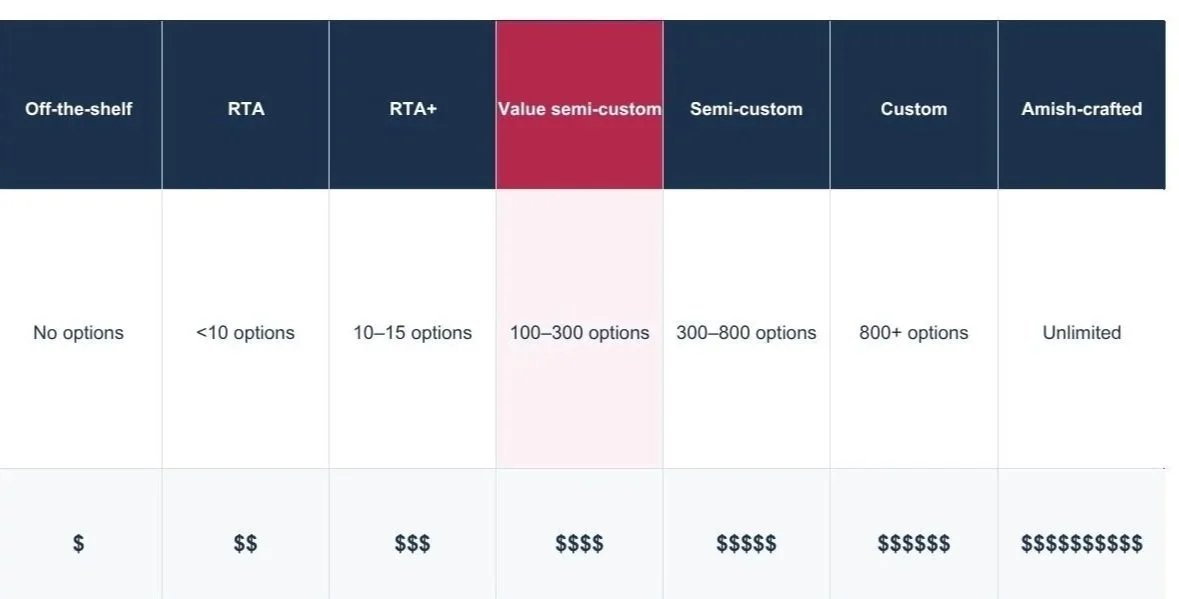
Simple answer: Options. Essentially, the more “options” you have available to you, the more expensive that cabinet is going to be.
Your next question: does that influence the performance of the cabinet? It depends. But let’s get back to cost first.
-
Wood species
Door style
Finish
Hardware quality, i.e., soft-close, full extension
Build quality – thickness of wood & joining
-
Other options you might consider would be
Distressing
Highlighting
Abnormal-size cabinets
Appliance openings
Appliance panels
End finishes
Trim finishes
Off-the-shelf | RTA | RTA+ | Value semi-custom | Semi-custom | Custom | Amish-crafted
No options | <10 options | 10–15 options | 100–300 options | 300–800 options | 800+ options | Unlimited
$ | $$ | $$$ | $$$$ | $$$$$ | $$$$$$ | $$$$$$$$$$
There are many more, but those would be your main ones to consider when figuring out what type of cabinets you want in your home.
Here are some examples and points for each of the types in the table above
-
These would be the cabinets that are sitting at Home Depot right now. You can go there, put it on a cart, check out, and bring it home. There are 0 options here, and they are usually unfinished (meaning you need to paint or stain them yourself). You get what you get, and if they don't have the size you need, then there's nothing you can do.
Helpful tip: if you are trying to get an idea of price based on cabinet prices you see listed for cabinets like these, then you will be very misled. See my other articles on pricing and costs to get an accurate picture of what you might spend.
-
Think IKEA cabinets: they come in a box, and you put them together yourself (or you pay your contractor to put them together). Funnily enough, they actually have a good selection of colors in painted, wood, metal, and glass. So, this specific manufacturer is sort of an outlier to my chart because they are a massive company. I keep them in RTA because there is no option for assembly or for the construction of the cabinets. One that we sell that does work for my options answer would be Northpoint Cabinetry.
-
Ready-to-Assemble Cabinets Explained
What pops into your head when you hear “ready to assemble”? Great, now let's talk about it because sometimes RTA gets a bad rap for good reason, and sometimes RTA is exactly what is needed.
Pros: Very cost-effective, short lead times
Cons: Fewer selections, fewer options for layout, someone must assemble them before installation.
In general, those are the pros and cons for RTA cabinets
-
Standard trims you need to any kitchen install are Toe Kicks, fillers and scribe
Trims you might need depending on your design and style are Crown, Baseboard, Skins, Panes, ¾ Panels, Dishwasher end panels, Decorative legs, Applied doors, Valences.
The standard trim package is generally very cheap compared to the cabinet boxes; I would anticipate maybe 5$ increase over the value you calculate.
If you are thinking of adding additional trims as mentioned above, I would probably anticipate a 15% increase in budget going into your design meeting.
-
All the pricing below is simply for materials only. No installation was priced out in these assumptions. Additionally, these are ranges and will vary based on location, vendor, and manufacturer, and these numbers are meant as a helpful budgeting guide and not a quote for a product.
Ready to Design Your Space with an In-House Expert?
Visit our Newark Showroom at 704 Interchange Blvd or call 302-731-2851 to schedule your free design consultation.